When you say to someone “draw a tree,” what they draw is, no matter how complex, visual shorthand for a tree. The picture does not capture the “being” of a tree. The beauty of the limbs. The complexity of a leaf. The texture of the bark. The sweet clean “tree” smell. In much the same way, when we say “I’ve…
Late period shirt for a 5-year-old
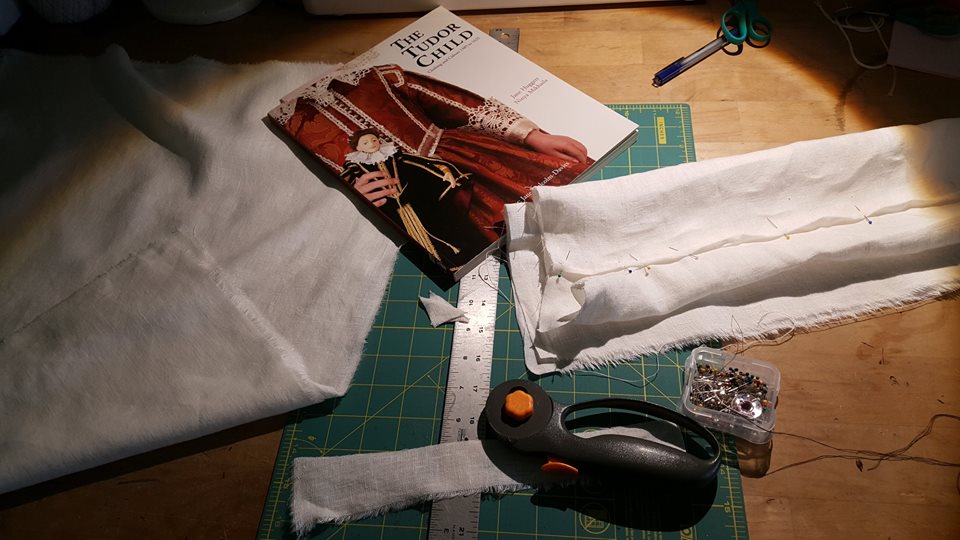
White linen shirt sized for a 5-year-old started June 15, 2018. Finished March 4, 2019. To be fair making this shirt went fairly quickly. Unfortunately I started making this for my son and then got pulled off to a lot of other projects. It probably only took about a week to sew it together but that was spread out over…
Tunic Sew Along: Finish your tunic
[Late to the conversation? See all of the tunic sew-along from the beginning] Step 6: Finish your tunic. Someone in my FaceBook page (Research Dumping Ground), asked “Why do you sew flat felled seams with the flap on the outside?” Good question. Initially, when I first started sewing tunics (2003-2004), it was because no one told me any different. Jeans…
Slip Stitch
I use the slip stitch for rolled hems, attaching linings and for applique. This is a stitch my mother taught to me and I use it on practically every garment I’ve ever made. I am right handed so if you’re left-handed you’ll have to do the mental gymnastics to reverse this. For my example I’m using brown button hole thread…
Tunic Sew Along: Trim your hem
[Late to the conversation? See all of the tunic sew-along from the beginning] Step 5: Trim your hem. If I were working on a full length tunic or a dress I’d have the recipient try it on with the shoes they plan to wear and a belt/appron if they plan to wear that and then mark where it hits the…
Tunic Sew Along: Construct your tunic
[Late to the conversation? See all of the tunic sew-along from the beginning] Step 4: Construct your tunic. First things first, thread. Use whatever thread makes you happy. For the construction of a tunic I like a nice 100% cotton thread or something with a polycore. I’ve been told that 100% silk or poly threads will cut through your fabric…
Anatomy of woven fabric
A loom holds the warp threads. The weft threads are then woven into the warp threads in a particular pattern. These are compacted to create fabric. The area at each edge of the warp where normally the weft threads change direction is referred to as the selvedge. When viewing a piece of fabric the warp threads will run parallel to…
Tunic Sew Along: Cut your fabric
[Late to the conversation? See all of the tunic sew-along from the beginning] Step 3: Cut your fabric. I’m following my updated Kragelund tunic pattern for Fearghus which I posted (and then updated) here**: Kragelund Tunic: Simplified Pattern My posted pattern already includes seam allowance for flat-felled seams at 1/4″ offset. To cut out the pattern I’m using the nip…
Flat-felled seam
My favorite seams for making tunics is the flat-felled seam. This seam works well on straight or only slightly curved edges. This type of seam is used on the sleeves of the Viborg Shirt which has been dated to around 1018AD. I normally sew this together with the “flap” on the outside of the garment. It’s really up to you…
Tunic Sew Along: Wash and dry your fabric
[Late to the conversation? See all of the tunic sew-along from the beginning] Step 2: Wash and dry your fabric. My view here is that you want to abuse your fabric as much as possible now and then baby it after it becomes a garment. So wash it on hot, add a nice amount of detergent, set your machine to…