Minoan/Mycenaean Source Materials

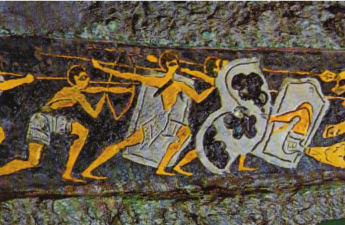
Bronze – Lion Hunt Dagger

Find spot:  Shaft Grave IV in Grave Circle A at Mycenae by Heinrich Schliemann in 1876Date: 1550-1500 BCEClothing depicted: kilt (shorts?), figure-of-eight shield and tower shield, spears, bow and arrowMuseum link: National Archaeological Museum in Athens http://odysseus.culture.gr/h/4/eh430.jsp?obj_id=4517 From the Museum link: This masterpiece of Mycenaean art displays a unique decorative technique known as ‘painting with metal.’ It is a bronze blade with four…
Continue Reading

Minoan/Mycenaean Source Materials

Fresco – Procession of Mature Women

Find spot:  Akrotiri, island of Thera (Santorini), Xesté 3, wall paintings, 1st story, north corridor wall and south corridor wall Date: 17th century BCE (circa 1600–1550 BCE)Clothing depicted: snood, heanos, cloak, necklace, Museum link: (probably) Museum of Prehistoric Thira, Santorini https://www.namuseum.gr/ en/collection/syllogi-archaiotiton-thiras/ “Excavated by Spyridon Marinatos in 1973, the upper portions of two of the figures were published in color in 1992 by Christos…

Continue Reading

Minoan/Mycenaean Source Materials

Fresco – Adorants

Find spot:  Akrotiri, island of Thera (Santorini), Xeste 3, Room 3, ground floor, north wallDate: 1600 BCE Clothing depicted: heanos, wrap skirt, earrings, necklaces, bracelets, fillet, hair pin, belt, veil, Museum link: Museum of Prehistoric Thira, Santorini https://www.namuseum.gr/en/collection/syllogi-archaiotiton-thiras/ cat. no of Akrotiri frescoes 233 Akrotiri was covered by volcanic debris following the eruption of the Thera volcano c. 1500 B. C. E.. This preserved many…

Continue Reading

Minoan/Mycenaean Source Materials

Fresco – Saffron gatherers

Find spot:  Akrotiri, island of Thera (Santorini), Xeste 3, Room 3, 1st floor, east wallDate: 17th century BCE (circa 1600–1550 BCE)Clothing depicted: heanos, wrap skirt, earrings, necklaces, bracelets, anklets, fillet, belt, shaved head, basketMuseum link: Museum of Prehistoric Thira, Santorini https://www.namuseum.gr/en/collection/syllogi-archaiotiton-thiras/ Akrotiri was covered by volcanic debris following the eruption of the Thera volcano c. 1500 B. C. E.. This preserved many of the buildings…

Continue Reading

Minoan/Mycenaean Source Materials

Ivory Pyxis from Mochlos

Find spot:  Mochlos, CreteDate: LM IB period (the end of the Neopalatial Period 1670-1430 BCE)Dimensions: the lid measures ca. 11 by 14 cmClothing depicted: heanos, wrap skirt, bolero jacket, loincloth with codpiece, shoes, necklaceeMuseum link:  Sitia Museum https://archaeologicalmuseums.gr/en /museum/5df34af3deca5e2d79e8c15b/archaeological-museum-of-siteia In Ancient Greece, a pyxis is a small, cylindrical container, typically with a removable lid, used to store small items such as jewelry,…

Continue Reading

Minoan/Mycenaean Source Materials

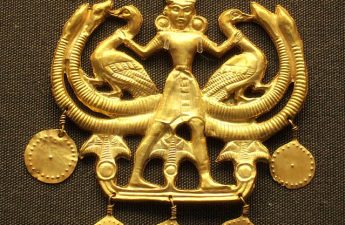
Gold pendant – Master of the Animals

Find spot:  AeginaDate: 1850-1550 BCEDimensions: 6 cm H, 6.30 cm WClothing depicted: kilt, bracelets, arm bands, possible belt, possible shoes or greavesMuseum link: The British Museum Item number 1892,0520.8 https://www.britishmuseum.org/collection/object/G_1892-0520-8 Gold pendant showing a nature god – the “Master of Animals”; he holds two geese, and stands among lotus flowers. Behind the god are stylised bull’s horns. The pendant is made of sheet gold,…

Continue Reading

Minoan/Mycenaean Source Materials

Fresco – Room of the Frescoes

Find spot:  Mykenai, Akropolis, Citadel House area, room 31 (“Room of the Frescoes”) Date: 1250 BCEClothing depicted: lily hat, possibly chemise, bracelets, tied wrap, heanos and/or bolero jacketMuseum link: Mykenai, Archaeological Museum 385  This is the largest fresco in situ. It includes three women on two different levels. The frescoes are located behind a household altar indicating that at least one of the women is…

Continue Reading

Minoan/Mycenaean

Aegean Bronze Age Men’s clothing

What did Aegean Bronze Age men (and boys) wear? Well..– they went naked (sometimes while carrying fish),– they wore zoma (loincloth)(plural: zomata) (sometimes with codpiece) (greek: ζῶμα Linear B spelling is zo-ma (𐀿𐀲).)– they wore hide skirts (possibly called perizoma)(greek περίζωμα)– they wore short kilts (possibly also perizoma) – they wore shorts (though there is a possibility that the shorts…

Continue Reading

Minoan/Mycenaean Source Materials

Fresco – West House – Boys with fish

Find spot:  Akrotiri, island of Thera (Santorini), West houseDate: 17th century BCE (circa 1600–1550 BCE)Clothing depicted: fish, necklaceMuseum link: Museum of Prehistoric Thira, Santorini https://www.namuseum.gr/en/collection/syllogi-archaiotiton-thiras/ Young boys with shaved heads and stray locks showing off stringers of fish Sources Ancient-Greece.org https://ancient-greece.org/art-architecture/akrotiri-frescoes/

Minoan/Mycenaean Source Materials

Fresco – The Mykenaia

Find spot:  “House of the High Priest” Southwest Building at the Acropolis of Mycenae, Cult CentreDate: 13th century BCEClothing depicted: heanos, bolero jacket, wrap skirt, bracelets, necklace, head wrap, beltMuseum link: National Archaeological Museum of Athens https://www.namuseum.gr/en/collection/syllogi-mykinaikon-archaiotiton/ What I see:She has two right hands. In “New Reconstruction of the “Mykenaia” and a Seated Woman from Mycenae” the author, Bernice R. Jones, notes,…

Continue Reading