Dress of the Court of Saxony

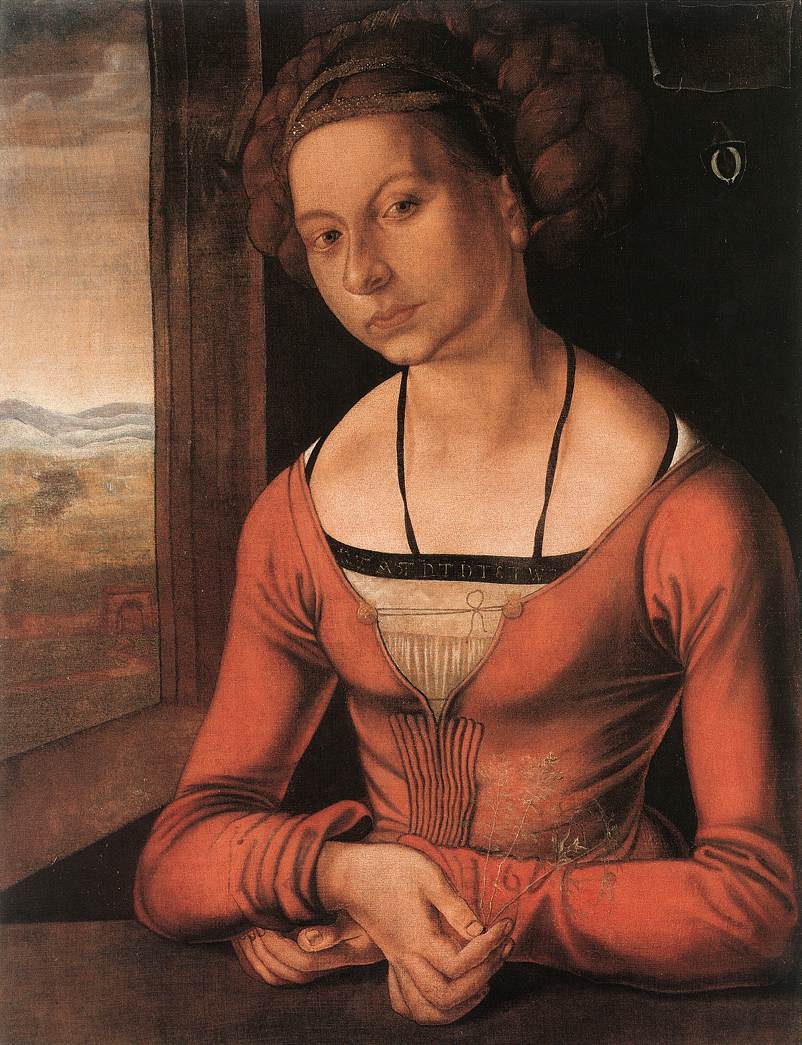
Saxony, GermanyThis style of dress proliferated in the Saxony region of what would be modern day Germany. Cranach the Elder was a court painter to Frederick the Wise of Saxony. During the time of the portraits under study (1520-1540) he had settled permanently at Wittenberg.
Identifying details:
- Wide front with laces showing below a decorated placket
- Skirt pleated into the bodice
- Head dress is sometimes braids on top of the head(<10%), or a goldhaube with or without a barret.
- Few portraits show slashed guarding. It's extremely rare.
- 90% of the guarding is gold or black.
- Sleeves can be elaborate.


Inspirational Pictures

Cranach, Lucas the Elder Judith with the Head of Holofernes c. 1530 Oil on wood, 87 x 56 cm Kunsthistorisches Museum, Vienna

Cranach the Elder, Lucas Judith Victorious c. 1530. Oil on wood. Beech panel, 75 x 56 cm. Jagdschloss Grunewald, Berlin

Mary Magdalene (?), Lucas Cranach the elder, ca. 1525 LINK


Cranach the Elder, Lucas. The Saxon Princesses (Sibyl, Emilia and Sidonia of Saxe). c.1530. Oil on wood. Kunsthistorisches Museum, Vienna, Austria.

Detail of right-hand princess from The Saxon Princesses. Note the lacing ring showing at the top of the picture. Picture found on Flickr


Cranach the Elder, Lucas, ca 1526. PORTRAIT OF A GIRL WITH FORGET-ME-NOTS (The Princess). Tempera and oil, beech boards; 34.9 x 23.8 cm LINK


Dress Diaries

Brown and Gold Gown made for Rolf and Aurora’s Purgatorio Step up August 2006
Arianwen’s Saxony Gown made for Arianwen to wear at October Crown 2010

Brown and Gold Gown

gr_dress_procession.jpg

Diary started October 13th 2005

Dress first worn: August 26, 2006.

saxony.jpg
Saxony, Germany

[Edit: After almost 2 years of calling this my "german" dress I've come to find out that
Cranach was a court painter to Frederick the Wise of Saxony. During the time of the portraits under study (1520-1540) he had settled permanently at Wittenberg. This means that we cannot take this style of dress to be the overall "german" style. It was popular in a limited geographic region over a limited amount of time. It also explains why it's so blasted hard to find any of this type of dresses painted by any other painters. So substitute "Dress of the Court of Saxony" for all references to "German" below.]

Summary

It’s so hard to be just French. I’m Sylvie. I’m french. But I’m also “Sylvie, timetraveler of fashion.”

I’ve developed a need to make a german gown. I didn’t mean to. I won’t let this suck up my life and make me spend every day morning, noon, and night looking for pictures of German ladies. I won’t!

I blame this on Etaine. It’s her fault with her perky bustling around in germans and her blasted friends bustling around in germans. I also blame Edith. With her “hey, we’re of German decent.. we should look smashing in German garb”. They’re all just evil.

Lastly I blame their Excellencies Rolf and Rory. With their german step up at Purgatorio. They have finally added a deadline to a never-started-because-I’m-intimidated-by-it project. *sigh* So I guess I’ll have Germans by Purg (in 5 weeks).

Research and Background

I have no idea what these garments would actually be called in German. I think I’ll stick with “dress”, “underdress”, “sleeves” and “stomache thingy”.

I think the fabrics looks like velvet or wool. I’ve been informed that wool flannel works very well. I’ll probably use that with probably a cotton or linen brocades for contrast.

My goal is to create a garment that is consistent with the fashions portrayed in the paintings of Cranach the Elder from around 1520-1530 Germany.

Details to include:

  • Skirt pleated directly to the bodice. I’m uncertain which type of pleat I’m going to use. Etaine says it was -always- cartridge pleated.. but I’m just not seeing that in the paintings. This will be attached directly to the bodice (probably with a french seam like I did with my italian dress) with a slit in the front for getting in and out of the dress.
  • Three bands of contrasing fabric in skirt of decreasing size from the floor to about knee high.
  • Bubbled sleeves at elbows and possibly shoulder
  • I love the little standing collar coat thingy.. but I’m not sure if I will be able to attempt that for my first one.

Inspirational Pictures

cranach5big.gif
cranach56.jpg
Cranach the Elder, Lucas.
Portrait of Christiana Eulenau. 1534. Oil on wood. Alte Meister Gallerie, Dresden, Germany.
cranach1528.jpg
Cranach the Elder, Lucas.
1528
CRANACH_Lucas_the_Elder_Portrait_Of_A_Young_Woman.jpg
Cranach the Elder, Lucas.
Portrait of a Young Woman. c.1530 Oil on wood
16 1/2 x 19 1/4 inches (42 x 49 cm)
Galleria degli Uffizi, Florence, Italy
nort.cranach.jpeg
Cranach the Elder, Lucas.
Lucretia Committing Suicide. c.1529. Oil on panel.
Sarah Campbell Blaffer Foundation, Houston
lucrezia.jpg
Cranach the Elder, Lucas
(German, 1472-1553)
Lucretia, 1535.

Credited as Cranach the Elder, Lucas 1512
. Problems: doesn’t resemble other Cranach images. 1512 is very early for this style.


From the back

01mysti1.jpg
Cranach the Elder, Lucas
The Mystic Marriage of St Catherine (detail)
c. 1516
Panel, 67,5 x 47,3 cm (full painting)
Museum of Fine Arts, Budapest
6fountai.jpg
Cranach the Elder, Lucas.
The Fountain of Youth (detail)
1546
Lime panel
Staatliche Museen, Berlin
12640127.000.jpg
Cranach the Elder, Lucas.
The ill-matched lovers


http://www.dhm.de/ausstellungen/kurzweil/season.htm

http://www.thinker.org/imagebase_zoom.asp?rec=6235304329530027

Landsknecht

fearghus_inprocession.jpg
Picture by Bianca

Diary started Jun 26, 2006
Outfit Finished on August 25, 2006.

Summary

landsknecht n.
from Landsknecht “servant or soldier of the country or land”: a European mercenary foot soldier of the 16th century, armed with a pike or halberd.

Fearghus is on court for TRH Rolf and Aurora. They are stepping up in Germans (Landsknecht) and have requested that their court wear german’s as well. This is 4 weeks away.

Research and Background

My research normally centers around 14th-15th century French outfits. So all of this is pinch research. Do your own research. If you don’t like my conclusions, good. Go find better ones.

I think the fabrics should be velvet or wool with probably cotton or linen brocades for contrast.

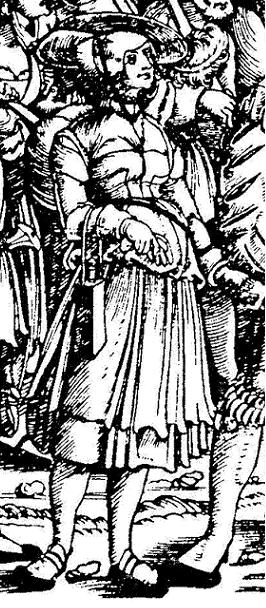
My goal is to create a garment that is consistent with the fashions portrayed in the woodcuts of Landsknecht from about 1550 Germany.

Details to include:

  • High necked linen under shirt with neck ruffles and ties.

  • Black waffenrock with green guarding. Lined in green linen. Waffe at above waist level to just-above knees.
  • Strumpfen (cloth hose) with Kniebänder. Tight pants with two ruffles at knees. Possibly with garter between the two ruffles.
  • ?? Gartered knee high socks Possibly not necessary if Strumpfen are full length.
  • Tellerbarret (pizza hat) with ostrich feathers.

I believe the -actual- outfit should have a fitted doublet beneath the waffenrock. Because of time pressures (and because I think it’s going to be stinking hot at Purg) I’m leaving that out of this iteration.

Resources

I found a lot of nice information here: http://www.st-max.org/redesign/costume-male.htm
Patterns for 16th century Men’s Costume from Germany by Michael de Lacy. Nice patterns for hose, linen shirt and doublet.
http://www.kimiko1.com/dressdiaries/CptnWaffenrock/index.html

Inspirational Pictures

Found at http://www.st-max.org/todesengel_woodcuts.htm

Hauptman.jpg
Hauptman-n-Dopples.jpg
Hurenweibel.jpg
Landsknecht_Artillery-4.jpg
MusterSchieber.jpg
Profoss.jpg
s2958.jpg
Trommelschlager.jpg


shert.gif
Woodcut from Mari’s class handout.
mocking_of_christ_grunewald_hose_detail.jpg
The Mocking of Christ
GRÜNEWALD, Matthias
1503
Oil on pine panel, 109 x 73,5 cm
Alte Pinakothek, Munich
PBruegel_restscholar.jpgBruegel, Pieter
The Land of Cockaigne,
1567.


Process

tmbcorsetpattern.jpg

Because I’m lumpy and have more breast than the 15-year-old models that Cranach used I need more support. I’ve decided to start with a corset. I’m following the pattern on the Sempstress.org site. The instructions seem fantasticly easy to follow and it results in a corset with laces positions along the edges of the front opening. Last night I made up my first attempt. Based on the final garment, it’s obvious that I suck at taking my own measurements. I need to lengthen it by about 5 inches and to remove about 4 inches from the circumferance. Today I’ll buy more fabric and make a second attempt tonight/tomorrow. Also need to buy more steel bones.

Ran off to Discount Fabrics at lunch (long hike for a lunch hour). Scored 7 5/8 yards of cotton-with-a-linen-look ($2/yd) to line his German outfit and 3 yards of brushed cotton twill ($3.75/yd) to make another attempt at a corset.

I talked with Etaine this weekend. She said that instead of making a corset (which is probably wrong for this dress style) and then fitting a dress over that corset I should instead make the dress and bone the front opening. That makes the dress much easier. I’m thinking run bone along the front edges. Whip lacing rings directly under the boning. Add additional boning if necessary to keep boob-age from leaking into underarms. Use hook and eye to attach front decorated and re-inforced placket to support boobage. So this is essentially like my italian dresses except that the boob will be supported by the decorated placket and the black lacings will run across the stomach, holding the bottom of the dress tight (under the boobs). Much easier than previous plan.
I’m hoping the wool comes this week. I want to make the bodice out of two layers of linen and use that to hold the boning and lacing rings. Then the wool will attach to the outside sort of decoratively. All the strength will come from the linen. I’m pretty sure I have some lovely dark-chocolate linen that would be perfect for this.
I can’t make the decorative placket until I receive the brown wool. I want to make sure that the colors work well together.
Hmmm.. option 2 is to make dress from linen and skip the wool part. That idea has potential. I have black velvet ribbons I used on italian dress. That would easily work on german dress. This idea bears thinking about.

After looking at lots and lots and lots of pictures I’ve finally started on this project. The first piece I’m making for him is the undershirt. I’m making a neckline as is seen in this woodcut.

shirt_diagram.GIF

I cut out two panels of linen 60″x60″. At the center of one I cut the front neck slit. I then sewed these together at the shoulders. That is at the top-right and top-left of the fabric I flatfelled the outer 10 inches* (leaving ~40″ at the neck opening). Then I went around and cartridge pleated the neck. I did three strands of thread and will cover this inside and out with bands that are about 1″ wide (it’s about 1/2″ from the selvedge edge of the fabric and the first strand.. then it’s about 3/4 inch from the top strand to the bottom strand). This leaves a nice finished ruffled edge (selvege) at the neckline.
* it’s about 9″ from his neck to the point of his shoulder. 9″ plus ~1″ for seam allowance.

collar.jpg

Last night I added the inner band to the collar. I really like the way it’s looking. I cut out a strip of linen about 2 1/2 inches wide by 60 inches long. I ironed it flat and then ironed edge folds into it. I think it’s about 1″ wide once the folds were added. I cut off 23 inches of that strip for the inner band. That gave me about 1″ to fold under at the ends (1/2″ for each end) and left 22″ for the finished band. His neck is 21″ around and I wanted to make it roomy so it doesn’t feel like it’s choking him.
I attached it at each end of the inside of the collar and then pinned it at the center, and 1/4 marks. Then it was just a matter of pulling on the cartridge pleat strings and evenly distributing the pleats around the collar.
The band is attached to the pleats with a combination of blind-hem stitch and whip stitch. Most of the stitches are invisible.. and those that aren’t, it’s white thread against white linen. I’m OK with that.
In the picture, the blue dots were my guide for putting the cartridge pleating into place. They were made with a water soluable fabric pen so they should wash out the first time I throw it in the wash after it’s finished.

Last night I finished the outer band for the collar. It looks like a collar. It fits around his neck and does indeed look like it’ll close without choking him. He’s a little amused because at the moment the shirt resembles a poncho with a fancy collar. I’ll fix that tonight by adding sleeves. Progress is good.

I added the sleeves 26×30 (30 is the length of the arm) and gusset (8.5″x8.5″). Because I started with 60″ wide linen it’s plenty roomy. No need to add gores.
The sleeves are about 10 inches longer than his arms. This is on purpose. I added cuffs and gathered (knife pleated) the sleeve into the cuff. This gives the shirt nice poofy sleeves. I’ll add laces to the cuffs so they stay around his wrist.
I fingerloop braided a nice long 5-strand braid in white silk. I used this to make the ties at the collar.
The shirt is done except for the laces at the wrist and finishing the neck slit. I’ll do the laces tonight. I want to wait until the Waffe is finished before I finish the neck-slit opening. Just to make sure it’s long enough.
I wanted to get a picture of this last night.. but he insisted that he should shave before any pictures were taken. So no pictures yet.

July 27, later that evening

finished_shert.jpg

I attached lacing rings on one of the sleeves. Then Fearghus and I both decided that it’d be better if it used buttons. Removed lacing rings. Added buttons and loops. Much nicer. Don’t you agree?
At this point I’m going to call the shirt 98% done and move on to the next project. I still need to do the following:

  • finish neck slit

  • open sleeves a little bit further so they an be rolled up
  • cut to final length and hem

I’ll come back to the shirt and finish the above.. probably after I make the Waffe.