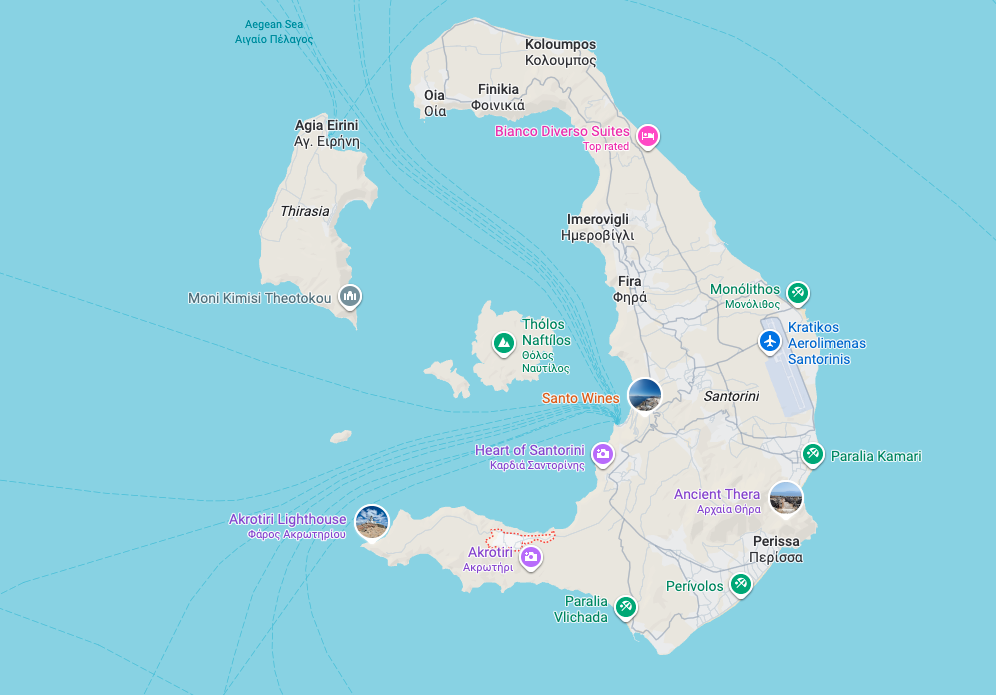
Thera (modern day Santorini) is the southernmost island of the Cyclades. It is 110 kilometers north of Crete. It was roughly circular, about 12 kilometers across with a volcanic cone at the center.
Akrotiri was a town on the southwestern tip of the island. It had two- and three-story buildings. The streets were paved and drained. The houses had indoor plumbing.
The volcano detonated in the mid-second millinnium BCE. The exact date is under debate, 1628 BCE vs 1530-1500 BCE depending on which evidence you use.
After the eruption the main part of the island collapsed into the caldera and was filled by the sea. The city of Akrotiri was covered by sixty feet of volcanicash and was preserved much like a Bronze Age Pompeii and in fact it has been referred to as “Pompeii of the Aegean”. This ash allowed Akrotiri to remain mostly undisturbed until Spyridon Marinatos began excavating in 1967.
Before the main eruption, the entire population of Akrotiri left. No bodies have been found. It seems that the inhabitants of the island had been warned (probably by earthquakes) that the volcano might erupt. It appears that all the people had relocated off of the island and had taken with them all of the possessions they could easily carry. It is not clear where they went.
Very little gold has been fund on the site but the excavations have uncovered buildings, streets, furniture, pottery, food storage, tools and frescoes.

Sources
National Archeological Museum: Collection of Antiquities of Thera https://www.namuseum.gr/en/collection/syllogi-archaiotiton-thiras/
Marinatos, Nanno. 1984. Art and Religion in Thera. Reconstructing a Bronze Age Society. Athens: D. and I. Mathioulakis. Print.