
Find spot: Akrotiri, island of Thera (Santorini), Xeste 3, Room 3, ground floor, north wall
Date: 1600 BCE
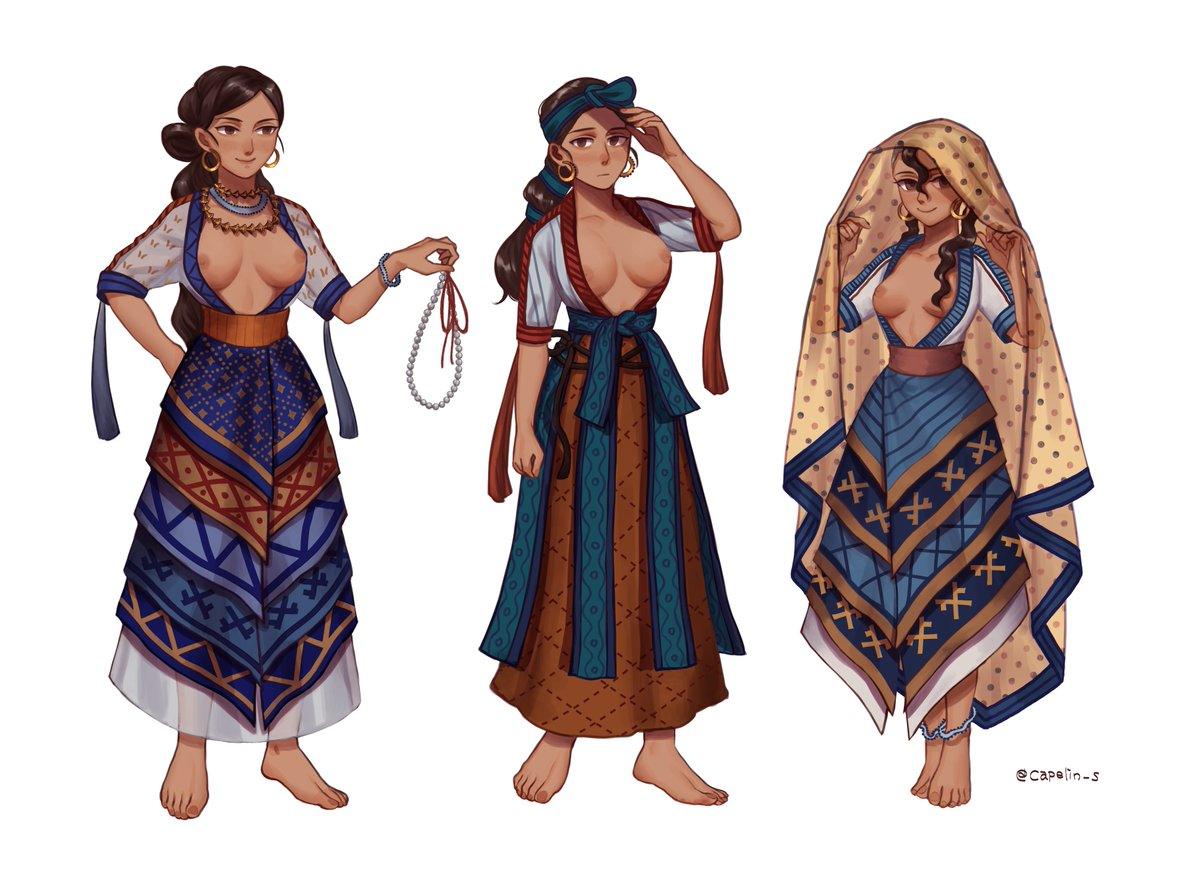
Clothing depicted: heanos, wrap skirt, earrings, necklaces, bracelets, fillet, hair pin, belt, veil,
Museum link: Museum of Prehistoric Thira, Santorini https://www.namuseum.gr/en/collection/syllogi-archaiotiton-thiras/ cat. no of Akrotiri frescoes 233
Akrotiri was covered by volcanic debris following the eruption of the Thera volcano c. 1500 B. C. E.. This preserved many of the buildings and delicate wall paintings.
These frescoes occur in a house with a adyton (lustral basin). These frescoes are widely regarded as evidence of female initiation rites.
The north wall of the ground floor depicts three females commonly referred to as “The Necklace Swinger”, “Wounded Woman” and the “Veiled Girl”.
The “Necklace Swinger” is an older woman who appears to be offering a necklace, possibly to a Goddess? She wears a diaphanous heanos and a wrap skirt. From “Aegean Dyes”: The Necklace Swinger wears a multi-layered flounced skirt and an open bodice, both of which appear standard in depictions of women from Xeste 3. She is adorned with several types of elaborate jewelry and wears a sash or ribbon in her hair. Both the sash and bodice feature the vibrant colors that are positively identified as dyes like those that came from the workshop on Crete. The sash, yellow with red borders, could have been dyed using weld and madder. The same two colors are found on the band that runs down the arm of the gauzy open bodice.
Although the woman’s silhouette is seen through the sheer material, purple crocuses with red stamens dot the fabric of her bodice. These decorative motifs may have been embroidered on the clothing, perhaps with woolen thread.
The “Wounded Woman” is wearing a atypical skirt (sometimes described as a sting skirt). She appears to have injured her foot. She has a hair pin and some kind of feather? grass in her hair. From “Stories of Coming of Age at prehistoric Akrotiri”: Close to the trickling blood, which is shown by vertical lines, the painter has depicted a crocus flower of which only the stigmas are immediately visible, in horizontal and not vertical arrangement, as would be expected if the flower were shown growing from the ground. It is the only flower in the area in front of the sitting female. Painted in purple pigment that has faded, the petals and pedicel are no longer discernible except in oblique light, in the paint ghost left on the white plaster of the ground (fig. 25). Slanting in relation to the vertical trickles of blood from the wound, the pedicel of the flower is directed at and touches the wound, essentially entering into it. It is obvious that here the Theran painter imprints with his brush, and with unique clarity, the core of an important mythological narrative, such as we shall meet again in the art of historical times, but there easily lisable thanks to the textual sources. Blood trickles from the wound of unknown cause in the female’s body and simultaneously the crocus is born, a flower that in Minoan religion is closely connected with female figures, which as a rule are interpreted as divine.
The “Veiled Girl” is wrapped in a diaphanous veil. Her shaved head indicates she is young. She wears a heanos and wrap skirt, though the skirt portion of her heanos cannot be seen. From “Aegean Dyes”: A similar color scheme appears on the Veiled Girl, who wears a white bodice with thick blue bands and thin red bands at the sleeves and shoulders. Additional bright red bands also decorate the back of the garment and, in the otherwise blank space, purple crocuses are painted. If the garment in the fresco actually existed, the bands and crocuses may have also been woolen embroidery, as was the case on the Necklace Swinger’s bodice. Additionally, the yellow veil that nearly covers the young girl may be the largest yellow textile preserved in Aegean fresco.
Sources
“Bronze Age Flower Power: The Minoan Use and Social Significance of Saffron and Crocus Flowers” https://www.researchgate.net/figure/The-Adorants-Fresco-from-the-north-wall-of-the-ground-floor-lustral-basin-in-Xeste-3-at_fig8_324530890
Valentinová, Lucie. (2024). The ‘Seated Woman’ of the Adorants Fresco from Xeste 3 at Akrotiri, Thera: Female Initiation or Non-Narrative Absorption ? https://www.researchgate.net/figure/Adorants-Fresco-the-Necklace-Swinger-the-Seated-Woman-and-the-Veiled-Girl-Xeste-3_fig1_386045395
Ancient-Greece.org https://ancient-greece.org/art-architecture/akrotiri-frescoes/
“Aegean Dyes.” Expedition Magazine 58, no. 3 (January, 2017): -. Accessed July 15, 2026. https://www.penn.museum/sites/expedition/aegean-dyes/
Papageorgiou, Irini. “Stories of Coming of Age at prehistoric Akrotiri: Rituals and iconographic correlations” (2011-2012) p. 48-49 https://www.researchgate.net/figure/este-3-space-3b-ground-oor-e-composition-from-the-south-wall-Detail-with-the-head-of_fig19_356987506.
Hatzaki, Eleni. “Pots, Frescoes, Textiles and People. The Social Life of Decorated Pottery at Late Bronze Age Knossos and Crete” (2018) https://www.academia.edu/88698664/Pots_Frescoes_Textiles_and_People_The_Social_Life_of_Decorated_Pottery_at_Late_Bronze_Age_Knossos_and_Crete.
