
Find spot: Mavrospilio Cemetery, Knossos
Date: 1450-1375 BCE
Clothing depicted: necklace
Museum link: Archaeological Museum of Heraklion https://ca.heraklionmuseum.gr/ ca/pawtucket/index.php/Detail/objects/357
From the museum: Necklace of spherical beads of semiprecious stones. There are 19 amethyst beads in various hues and two of carnelian. The necklace is a funerary offering from the cemetery of Mavrospilio, on a hill above the River Kairatos. The Kairatos flows through the Knossos Gorge, runs east of the palace of Knossos and meets the sea at Katsambas, 1.5 km east of the centre of Heraklion. Amethyst was imported to Crete very early on, in the Prepalatial period: a typical example is a bead in the shape of a bull’s head (necklace inv. no. Σ-Κ786) from the Mochlos cemetery. There was an organised amethyst-working workshop in the Minoan harbour town of Poros, Heraklion, in the Late Minoan I period, where raw and unfinished pieces of amethyst and other semiprecious stones were found in situ.
From Openhands:
Prompt: Read the Annual of the British School at Athens 28 (1926-1927) and tell me all of the pages in the document that reference the Amethyst and carnelian necklace. Specifically I’m looking to find out the sizes of the beads in the necklace in mm.
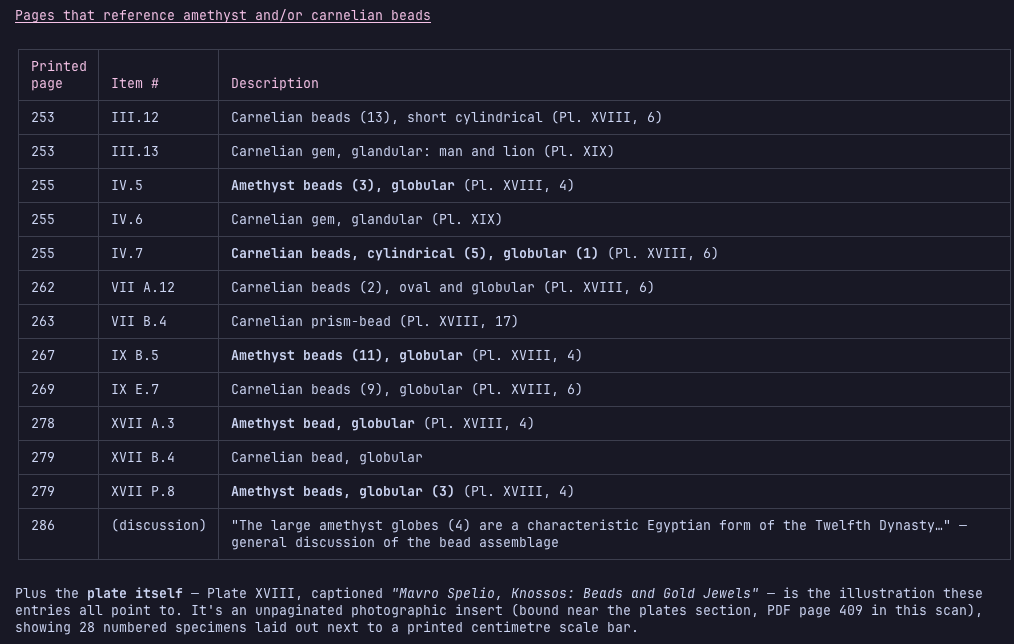
On the mm sizes — important caveat
I searched the full text of the article closely, and Forsdyke does not give explicit millimetre measurements for the amethyst or carnelian beads anywhere in the prose. The catalogue entries only describe shape and count (e.g., “globular,” “cylindrical”). The only explicit mm figures in the entire paper are for an unrelated gold signet ring on p. 269 (IX E.1: hoop diam. 13 mm, bezel 10 mm × 8.5 mm) — not for these beads.
The one way to get bead sizes is to measure them directly off the Plate XVIII photograph using its printed cm scale bar. I did this (measuring pixels against the scale bar in the scan): the large amethyst globular bead (item 4) works out to roughly ~11–12 mm in diameter, and the elongated carnelian bead (item 6) to roughly ~17–18 mm long × ~8 mm thick, with the smaller round carnelian beads in that same string around ~8–9 mm. Please treat these as rough estimates derived from a 1927 halftone scan, not as measurements stated by the author — they could easily be off by a millimetre or two.
If you need genuinely precise dimensions, the reliable path would be to check Forsdyke’s original excavation notebooks/museum accession records (likely at the Ashmolean or Heraklion Archaeological Museum, where the Mavro Spelio finds are held), since the published article simply doesn’t report them numerically.
Sources
Forsdyke E. J. 1926-1927. “The Mavrospelio Cemetery at Knossos.” Annual of the British School at Athens 28 (1926-1927): 243-296. https://www.jstor.org/stable/30098237?googleloggedin=true&seq=56
Annual of the British School at Athens 28 (1926-1927) https://dn721903.ca.archive.org/0/items/annual-of-the-british-school-at-athens_1926-1927_28/annual-of-the-british-school-at-athens_1926-1927_28.pdf